
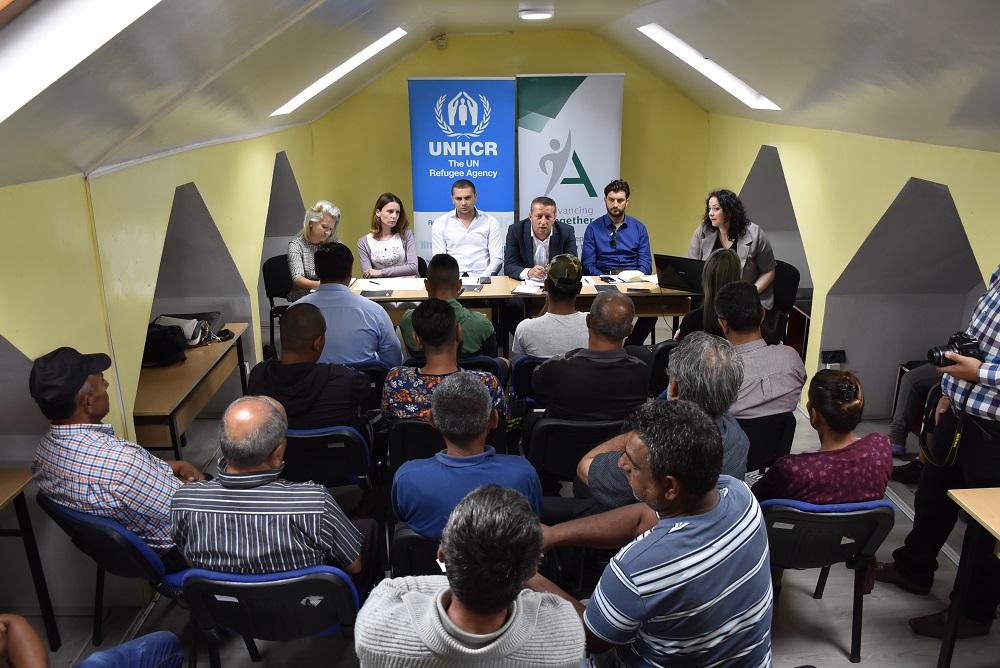
A meeting to discuss legal remedies and mechanisms for the
protection of community rights, with a focus on securing the right
to financial social assistance, was held at the Roma Youth Center
in Gračanica.
On behalf of the Municipality of Gračanica, the meeting was
attended by the Deputy Mayor, Saša Danić, an officer of the
Social Welfare Center Gračanica, based in Laplje Selo, Sonja
Nešić, and a representative of the Office for Communities and
Returns, Leutrim Ajeti.
The Deputy Mayor of Gračanica municipality, Saša Danić, who
pointed out that the local self-government was dedicated to the
improvement and protection of the rights of minority communities,
addressed the present first.
"That's exactly why such meetings serve to openly and directly
discuss the current problems, in order to work together on their
resolution, regardless of cultural, ethnic, religious and other
affiliation. The Municipality of Gračanica is open to everyone,
because we all share the same problems and we have to fight
and live together", Danić said.
At today's meeting, the most talk was about the right to social
assistance. The conditions and criteria for obtaining financial
social assistance to vulnerable families were discussed in detail
by an officer of the Social Welfare Center Gračanica, based in
Laplje Selo, Sonja Nešić.
"Social assistance is regulated by the Law on Social Assistance
Scheme in Kosovo. The parties are dissatisfied when they are
denied, and therefore, they must understand that they are not
denied by officers or the Welfare Center as an institution, but by
regulations. The question is whether the law is strict or not, higher
authorities should work on it before its adoption", said Nešić.
"The Social Assistance Scheme defines that it is given exclusively
to poor families, not to an individual. We have cases where
people come for a sick member, however, it is specified that the
dole is not given to an individual but to a family. Often people
interfere social assistance with family allowance, because one of
the conditions is that you have a child under five. It is not the
family allowance, but an allowance that the family gets in the
amount of five euros if it enters the social assistance program",
she added.
Nešić pointed out that before submitting the request, a party was
obliged to prepare all the necessary documentation. "We are
obliged to enter everything into the database. It is therefore very
important the applicant is honest, because if a different fact is
established in the field, the party may be denied. It is important to
list all family members and the correct address. We cannot say for
somebody that he is a single parent, if there is no court decision
and the like", Nešić said as an example.
She added that if someone did not have the necessary
documentation, the officer was not obliged to receive the request,
but to provide parties with all necessary information that would
help them to exercise their rights.
The meeting at the Roma education center was also attended by
representatives of organizations in the field of protection of
citizens' rights – Ombudsman Office and Regional Office for Free
Legal Aid, who explained the participants the possibilities for
exercising their rights.
The meeting was organized by Advancing Together (AT)
organization with the support of UNHCR.